Our first medaka book has been published: Medaka - The Handbook for Keeping and Breeding, written by Matthijs van der Velden, the breeder behind Medaka.nl. From November 2026 the first print run is available in the webshop.
Written in Dutch and fully in colour: the paperback has 157 pages and measures 15.2 × 22.9 cm. Meant for people who keep medaka in a tub, an aquarium or a garden pond, from beginner to advanced breeder. Short sentences and explained jargon keep it readable from about age twelve.
Why There Was a Dutch Handbook for Medaka
If you want to keep medaka, you currently have to piece together information from forums, foreign sources and advice that contradicts itself. Part of it is meant for a different climate, part for a different fish. That is difficult when you simply want to know what to do with your own tub, container or pond.
Behind the book stands thirty years of keeping aquarium fish; today the author keeps only rice fish: medaka. What is in the book comes from those years at the water. From them come the answers to questions a keeper really runs into: what do I buy, what do I set up, what do I feed, when do I step in and when do I leave the fish alone.
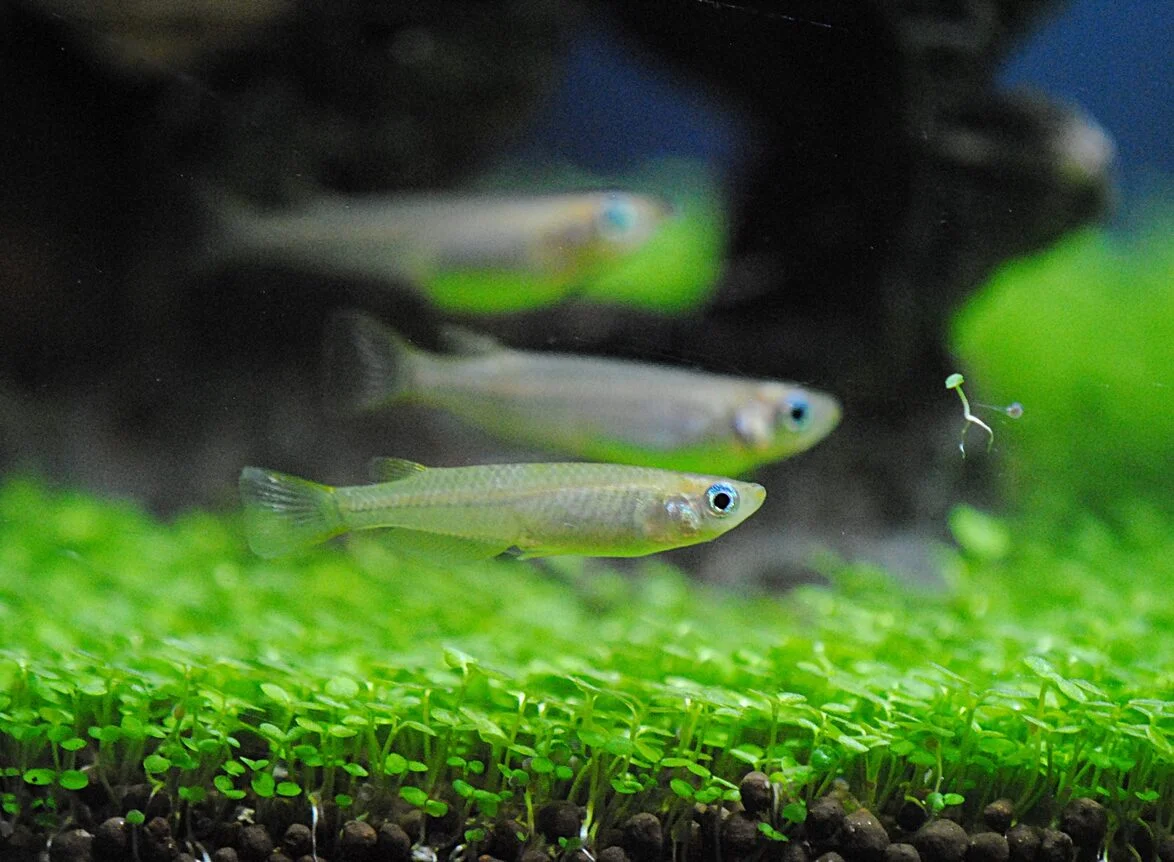
There is also some background. Temminck and Schlegel described the fish in 1846 in the Fauna Japonica, and in Japan it has been kept for centuries. What swims in the shop is a breeding form that does not belong in the wild. Since 2012 researchers even know of two species, a southern and a northern one. That explains a lot about how the fish behaves in your water, and the book explains it without turning it into a history lesson.
What is in the medaka book, part by part
Nine chapters in four parts, a glossary and a closing section: the structure follows the path of a keeper, from the basics through feed and breeding to names and finally the whole year.
| Part | Chapters | What it covers |
|---|---|---|
| I, The Basics | 1. Understanding Medaka, 2. History: From Rice Paddy to Pure Line, 3. Buying and the First Month, 4. Housing, Water, Substrate and Plants | The fish, its origins, the start and the setup of your water |
| II, Feed and Breeding | 5. Nutrition and Growth, 6. Breeding | What you feed and how you raise eggs and fry |
| III, Names and Quality | 7. Varieties and Names | The atlas and reading a name |
| IV, The Whole Year | 8. Diseases, Signs and Prevention, 9. Winter Months and Season Management | Health and Overwintering |
The feed chapter covers the three feeds from the breeder's range: Baby Meal, Grow Up Meal and Adult Meal. The book explains why floating feed is the rule. An extruded pellet traps air and keeps floating, and a pellet that still sinks after a few minutes is a signal. Green water returns in that chapter as the first food for fry.
For the substrate, the housing chapter sets a fixed build-up: one third soil at the bottom and two thirds washed play sand on top, in thicknesses of 9, 12 and 15 cm.
The atlas of thirty varieties and how to read a name
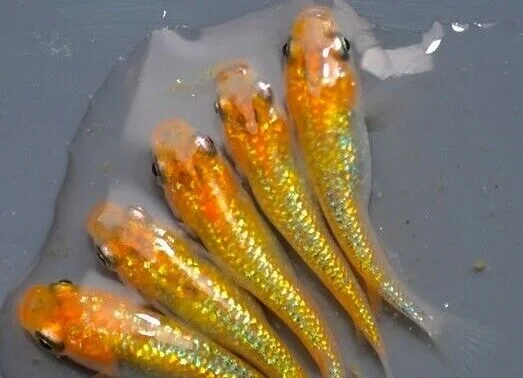
Medaka have names that look unreadable at first glance. The medaka book contains an atlas of thirty varieties. Each portrait gives the Japanese name, the reading and one line on what characterises the variety. So you quickly see what you have, and you know how to pronounce the name.
The structure of such a name is covered too: first colour or pattern, then scale type, then gloss, then fin or body. With that order you can parse a name the book itself does not mention. If you see a new name on a sales site or in a Japanese catalogue, you can cut it into pieces and know roughly what is meant.
That helps when buying and when judging what you buy. A name that does not fit the order, or a description that does not match the fish, is a reason to ask questions. The history, from rice paddy to pure line, provides the background: why quality in medaka is about pure lineage and not just colour.
What the book gives you for your own water and season
What you take from it are things you can apply yourself. A few examples that recur in the book:
- A rule of thumb for incubation time, so you know when to expect eggs.
- A quick-reference table in the disease chapter, from sign to likely cause to first action.
- The signal of a pellet that sinks, as an indication that the feed does not suit your fish.
- Which fish go into winter you choose with the winter selection in autumn, not by luck.
The rule of thumb for incubation is that the temperature in degrees Celsius times the incubation time in days is roughly 250. At 25 °C eggs hatch after about ten days, at 20 °C after about twelve and a half. Anyone who wants to breed medaka will also find in the same chapter how many males and females to put together and how to separate eggs and parents.

In the disease chapter every disease gets the same three questions:
- What is it?
- How do you recognise it?
- How do you prevent and treat it?
Medicines and dosages are deliberately not included. You read what you do yourself with water, warmth, oxygen and insulation. After that the winter chapter goes through the season: autumn, the start, sludge, frost and ice, what to do when a fish has to come indoors, and spring.
The first print run is here, and what comes next
With this first print run the breeder has something that goes beyond a webshop with fish and feed. This medaka book is not a reference for the shelf; it is a book to stand with at the water. You open it at the tub, at the pond or next to the aquarium, read a chapter, and carry on with your fish.
An edition in other languages is on the agenda. An e-book and an Amazon edition are also in preparation. That is an outlook, not a promise with a date. As soon as there is news, it will appear on this site.
The paperback costs 27.95 euro and can be ordered via the webshop. Prefer a bookshop via the printer? Then you can also find the book in the Lulu bookshop. Each copy is printed after ordering, so expect a delivery time of a few weeks.
Further reading
- What are Medaka rice fish?
- Breeding medaka: from egg to adult rice fish
- Winter selection in medaka: who stays, who goes
- 5 reasons why green water is good for your fry
Frequently asked questions about the medaka book (FAQ)
Where can I buy the medaka book?
In our own webshop at medaka.nl. If you prefer a bookshop via the printer, you can also find the book in the Lulu bookshop.
How long does delivery take?
After your order the book is printed (print-on-demand) and shipped as a separate package. In the Netherlands the expectation is 15 to 18 working days, so roughly two to three weeks. If you order the book together with other items from the webshop, the book arrives separately.
Is there also an e-book?
Not yet. An e-book and an Amazon edition are in preparation, but no date is known. For now the book exists as a 157-page paperback in colour.
Who is the book for?
For anyone who keeps or wants to keep medaka, in a tub, an aquarium or a garden pond. Starting from the basics it goes on to breeding, names and overwintering, so beginners and advanced keepers both find something. Short sentences and explained jargon keep it readable from about age twelve.
Does it include a treatment or medicine against diseases?
No. The disease chapter deliberately contains no medicines and no dosages. For each disease you read what it is, how you recognise it and how to prevent and treat it, using water, warmth, oxygen and insulation as tools. A quick-reference table helps you go from what you see to the likely cause and the first action.
Get 10% off your first order when you sign up for our newsletter.