The shoebox method: Raising medaka young brood
Who ever medaka has raised young brood, knows how frustrating it can be. You put the babies in a large aquarium with the best intentions, and yet only a small percentage survive the first few weeks. In Japan, where the medaka has been kept and bred for centuries, enthusiasts have found a clever solution for this: The “shoebox Method”. this technique revolves around raising young brood in small, shallow containers instead of large containers. it May sound counterintuitive, but there is a clear logic behind it that can drastically improve your growing Results. in this article we explain why small volumes work so well, how to apply the method yourself, and what you should do daily to keep your young brood healthy.
Why small containers work wonders for young brood
The idea that bigger is always better does not apply when it comes to raising medaka larvae. Newly hatched young brood are extremely weak swimmers. They have little muscle strength and can barely move through large amounts of water. In a large aquarium, their food spreads over a huge surface area, making the chance of a larva actually encountering a food particle very small. Many young brood simply die of hunger, not because there is none feed is, but because they never reach the food.
The shoebox method solves this problem by drastically reducing the living space. In a container of, for example, 20 by 30 centimeters with only a few centimeters of water depth, the distance between a larva and a piece of food is always small. This greatly increases food density: there is simply less water into which the food can disappear. For weak swimmers, this means that they have to waste much less energy to find something to eat, which directly leads to a higher chance of survival and faster growth.
The logic behind the shoebox method explained
To really understand why this method works, you need to look at the mathematics of probabilities. Imagine spreading a certain amount of feed in a one hundred liter container versus a two liter container. In both cases, each larva theoretically receives the same amount of food per liter of water, but the chance that a larva will actually encounter that food is completely different. In the small tank the distance that a larva has to cover is minimal, while in the large tank a larva can easily swim around for hours without ever passing a food particle.
This is the core of the causal logic: small volume means a higher food encounter probability for weak swimmers. It is not about the total amount of food, but about the density and the chance of contact. Young brood has hardly any reserves in the first two to three weeks and has to eat small amounts almost continuously. Each missed feeding round costs growth or, in the worst case, the life of the larva. By limiting the volume, you force the food and fish closer together, so that chance plays less of a role and survival becomes a lot more predictable.
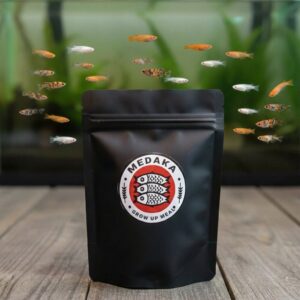
For the nutrition it is smart to start with special fine food for larvae. Us medaka fish food baby meal is tailored to this and has a particle size that suits the small mouths of newly hatched young brood. In combination with a small tank volume, you get the best of both worlds: fine enough food and a high chance that the larvae will actually find it.
Manage water quality and nutrition in a small volume
A small volume of water also has disadvantages, and you should be prepared for that. Water quality can change very quickly in a shoebox because there is simply less water to dilute waste products. Ammonia and nitrite, from undigested food and feces, can reach harmful levels in just a few hours. This means that you have to feed more accurately: it is better to feed small amounts more often than one large portion that remains partly uneaten on the bottom and starts to rot.
Another aspect that is often underestimated is surface tension. In a small, shallow container, the water surface area is relatively large relative to its volume, and newborn medaka larvae can literally become stuck to the surface due to surface tension. This is a known problem and can lead to drowning or exhaustion of the larva. To prevent this, you can add a little floating plants such as duckweed, or keep the water level slightly higher so that the larvae can more easily stay below the surface. Some growers also use a light layer of foil or a splash of dish soap on the edge of the container (not in the water) to break the tension, although this only works as an additional measure.
As soon as the young brood get a bit older, usually after two to three weeks, you can switch to slightly coarser food. Us medaka fish food growth meal has been developed precisely for this phase and helps the young fish continue to grow without falling into too large particles that they cannot yet process.
Comparison: small volume versus large volume for young brood
| Aspect | Small volume (shoe box) | Large volume (aquarium) |
|---|---|---|
| Food meeting opportunity | High | Low |
| Water quality stability | Variable, rapid change | More stable, more buffer |
| Risk of surface tension | Higher, extra attention needed | Lower |
| Control over feeding | Very accurate as possible | More difficult to dose |
| Maintenance frequency | Daily, sometimes several times | Less frequent |
| Growth rate of young brood | Often faster due to better eating behavior | Often slower |
Daily maintenance: this is how you keep the bowl healthy
With the shoebox method, daily maintenance is not an option, it is an Obligation. because the volume is so small, little can go wrong before the water quality noticeably Deteriorates. a good daily routine consists of a few fixed steps that are best repeated every morning and evening.
Below is an overview of what you should check and do every day:
- Check feed: check if there is any uneaten food on the bottom and remove it with a pipette or small scooping net.
- Feed small amounts: Feed a minimum amount of food two to four times a day, just enough to be eaten within minutes.
- Check water temperature: make sure the temperature remains stable, large fluctuations are more harmful in small volumes.
- Water change: Replace ten to twenty percent of the water every day with tap water that has been allowed to degas for at least a day, or use older aquarium water.
- Visually inspect: pay attention to swimming behavior, color and whether all larvae continue to move actively.
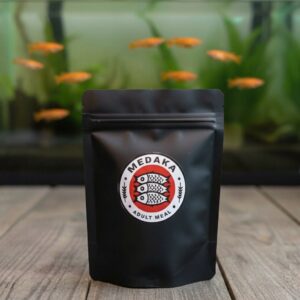
You can use us for adult medaka that you may keep separately as a breeding flock medaka fish food adult mealSo that the parent animals remain in top shape and produce healthy eggs.
In addition to the daily routine, it is smart to check more thoroughly every week. Test ammonia and nitrite levels if you are unsure about water quality, especially if you notice larvae becoming lethargic or clinging to the surface. A simple test strip costs little and can warn you in time before things really go wrong. Remember that small volumes are unforgiving: where a large bin can catch mistakes, a shoebox often punishes negligence within 24 hours. Consistency is therefore more important than perfection, as long as you maintain the basic routine.
Receive a 10% discount on your first order when you sign up for our newsletter.


Leave a Comment
Your email address will not be published. Required fields are marked *