4 foods that boost the red in your youkihi medaka
Anyone who keeps Youkihi Medaka knows how special that deep, fiery red color can be. But that color does not come naturally, it is a combination of genetics and nutrition. Even the most beautiful red Medaka can fade if the diet does not contain the right building materials. In this article we discuss four foods and pigments that have a direct effect on the red intensity of your fish: carotenoids, astaxanthin, spirulina and krill. We explain how these substances work, what to look for on food labels, and how best to feed your Medaka to really make that color pop.
Carotenoids: the basis of a bright red color
Carotenoids are the umbrella group of pigments to which almost all red coloration in fish can be traced back. A Medaka's body cannot produce these substances itself, so they must be supplied through food. Without sufficient carotenoids in the diet, the red color remains dull or even fades after a few generations. This is exactly why diet choice plays such a big role in breeding colorful Youkihi Medaka.
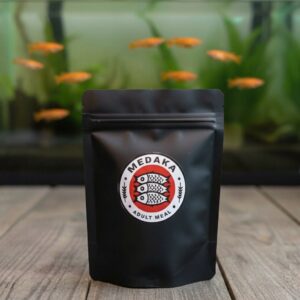
There are different types of carotenoids, and not all have the same effect. Some provide yellow or orange tones, while others contribute specifically to deep red. It is therefore smart to choose food in which deliberately chosen carotenoids have been added, aimed at red pigmentation. Us medaka fish food adult meal is formulated for this purpose, with a mix of pigment-enhancing ingredients that support natural color development without having to rely on artificial colorants.
Astaxanthin: the most powerful color pigment for Medaka
If you are looking for the most effective pigment for red Medaka, astaxanthin is the name you should remember. This carotenoid is known as one of the strongest natural colorants in the fish world and is widely used in feeds for salmon, shrimp and ornamental fish. Astaxanthin is efficiently absorbed by the body and used directly for pigmentation in the skin and scales, resulting in a vibrant, deep red glow.
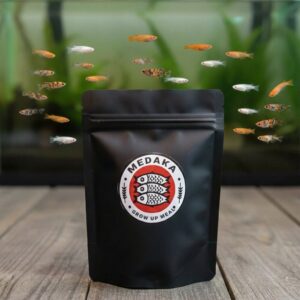
When looking at feed labels, it is smart to actively search for the terms "astaxanthin" and "canthaxanthin". Both ingredients are often mentioned together and have a direct link with the red coloring of your fish. Astaxanthin is generally more potent and natural in origin, while canthaxanthin is often added synthetically but is also effective. When you see these ingredients on the label, you know the food has been specifically developed with color enhancement in mind. Us medaka fish food growth meal contains astaxanthin as part of the formula, specially tailored to growing Medaka that have yet to develop their adult color pattern.
Add spirulina for extra depth of color
Spirulina is a blue-green algae that has been popular in aquaculture for years due to its rich nutritional profile. In addition to proteins and vitamins, spirulina also contains natural carotenoids that contribute to color intensity. What makes spirulina extra interesting is that it not only enhances the red tones, but also provides a healthier overall skin tone and a shinier scale pattern. This makes it a valuable addition to pure pigment sources such as astaxanthin.
Many Medaka enthusiasts find that fish fed spirulina regularly develop a richer and more saturated color than fish fed only standard food. This is because spirulina supports metabolism, allowing pigments to be absorbed and processed more Efficiently. this Is extra important for young medaka, because their color pattern is still developing. Us medaka fish food baby meal is therefore enriched with spirulina, so that young fish receive the right building blocks for strong, healthy color development from the start.
Krill as a natural boost for red pigmentation
Krill is a small crustacean that is naturally rich in astaxanthin, making it one of the best natural ingredients for color promotion. The special thing about krill is that the pigment is in a form that closely matches the natural nutritional needs of fish, meaning that absorption is often better than with synthetic variants. In addition, krill contains valuable fatty acids and proteins that benefit the overall health of your Medaka, which also indirectly contributes to a radiant color.
Many advanced breeders use krill as a supplement to their standard feed, specifically in the weeks leading up to shows or when they want to maximize the color of their fish stock. The great thing is that krill not only works for adult Medaka, but is also suitable for younger specimens, as long as the particle size is small enough. If you combine krill with a well-composed basic food, you will often see a difference in the intensity of the red color within a few weeks. This makes krill one of the most prized ingredients within the Medaka hobby.
Comparison of the four food sources
To keep an overview, we have placed the four foods discussed next to each other in a table. This way you can see at a glance which fabric best suits your purpose.
| Power source | Strong color effect | Additional benefits | Suitable for |
|---|---|---|---|
| Carotenoids (general) | Average | Basic building block for pigmentation | All ages |
| Astaxanthin | Very high | Fast and deep red coloring | Growing and mature Medaka |
| Spirulina | Medium to high | Supports metabolism and skin glow | Young and adult Medaka |
| Krill | High | Rich in proteins and fatty acids | Advanced breeders, show fish |
As you can see, these ingredients complement each other well. Astaxanthin and krill have a strong short-term effect, while carotenoids and spirulina provide a stable basis in the long term.
Practical tips to enhance the red color
In addition to choosing the right food, there are a number of practical things you can apply to achieve the best results. Below is an overview of the most important points of interest:
- Always check the label. Look for the words “astaxanthin” and “canthaxanthin,” which are the strongest indicators of a color-enhancing food.
- Vary the diet. Switching between different pigment sources provides a broader spectrum of carotenoids.
- Feed consistently. Color development is a slow process, you usually only see results after several weeks to months.
- Pay attention to water quality. Stress due to poor water values can negatively affect color development, regardless of the food.
- Combine food with natural supplements. Consider krill or spirulina in addition to your standard food for extra pigment power.
In addition, it is important not to forget that light also influences color perceptions and pigment development. Fish that live in well-lit water with sufficient UV light often show a more intense color than fish in dark, shady environments. In combination with a good diet, this works as a kind of catalyst for color development.
Frequently Asked Questions
How quickly will i see results after switching to color-enhancing food?
In general, it takes between four and eight weeks before you see a clear change in the intensity of the red color. This can vary from fish to fish depending on age, genetics and overall health.
Can i use astaxanthin and spirulina together?
Yes, these two ingredients complement each other well. Astaxanthin provides immediate pigmentation, while spirulina supports absorption and metabolism.
Is krill suitable for all life stages of Medaka?
Krill is suitable for both young and adult Medaka, as long as you pay attention to the particle size. For baby fish it is important to grind krill finely or choose it as raw material
Receive a 10% discount on your first order when you sign up for our newsletter.


Leave a Comment
Your email address will not be published. Required fields are marked *